

A few years back I had one of my inadequency episodes, this time around how poorly read I was. For someone who had once been certain he’d be a writer I had spent most of my adult life reading little and writing less, I simply never developed the discipline for it. So I scrambled and began to collect novels to read as if the fervor could make up for the inconsistency. Over the years I have stuttered and stopped a dozen or so gargantuan novels and inbetween those doorstoppers I can occasionally manage to eek out a full read of a more modest book. One of these novels has stuck with me, more because of a certainty it was actually written for me specifically than anything within it. This book seemed to be telling me a secret about myself I wasn’t supposed to know because the series wasn’t over yet. I can’t tell you what that secret is because the moment I leave the book I lose it. Zero Parades doesn’t make me feel that way. It makes me feel like I’ve never been further from it.
The Ghost of Disco
Zero Parades: For Dead Spies is the second release from studio ZA/UM, developers behind 2019’s Disco Elysium which may be the most lauded RPG of its generation. Political and natural in ways the ever increasingly corporate world of games never are, Disco Elysium is a phenomenal game whose story has been overshadowed by the internal turmoil of ZA/UM in the years since, with major creatives being ousted and replaced. The truth of the story is beyond the scope of my review and I suspect beyond the capabilities of most everyone not directly involved in the legal proceedings, but the duelling narratives that have blossomed out of the heap are those of the capitalist system wringing talent out of a one of a kind talent, and those of the collective behind Disco Elysium being emancipated from their “auteur” handlers. I suspect the former is closer to the truth, but the results for most seem to have manifested as total indifference. Despite the circles I hang in being the artsy fartsy types to jump at anything communist adjacent I haven’t seen any real discussion around the game pre-release. Not hype, not spite. Only I seem to have even bothered to ask the question.
To understand Zero Parades I first have to understand Disco Elysium because without one the other cannot exist and not in an influence sense, in a literal economic one. ZA/UM’s existence is due to the success of its predecessor and that seems to be due to the work put in by members stripped out of the company, the mental image of a husk left to write poetry after its thinking implements have been removed to keep it lean and compliant. Or has it? It still has eyes, a liver, a stomach, a heart, and greater works have been made for less. So if ZA/UM can pull it off, then the remnant talent is worth respecting and the historic tragedy of Disco Elysium’s Lobotomy may be softened as an unfortunate chapter and not the tragic end it seemed to be.
So inbetween sessions with Zero Parades I return to Disco Elysium and try to distill it. To this end, Zero Parades is a major boon, acting as a sieve through which I can filter the parts of its predecessors that are format standard and the parts that really define it. This ends up being more perplexing than enlightening because what I find in one I find in the other, but diluted and re-concentrated in ways that evoke a unique flavor, one along the lines of Elysium without mimicking it. They may both be tangy and sweet, but you’d be hard pressed to say an apple and an orange taste the same.
Welcome to Portofiro
Zero Parades puts you in the shoes of Hershel Wilk, Operant CASCADE of the espionage organization Opera on assignment to the island nation of Portofiro where in the not so distant past we fucked up royally and left our friends out to dry. Now back in the field for the first time since that historic loss, we’ve been entrusted with a new assignment, and a new redemption. The only problem is our lead on the op is catatonic in his room, zeroed out by melancholic pop music. With nothing but rust to our name we take to Portofiro to retrace our other’s steps, figure out our job in the first place, and reclaim our rep in the Opera. Along the way we encounter our old assets and discover what’s become of them in the embers of a burn notice.
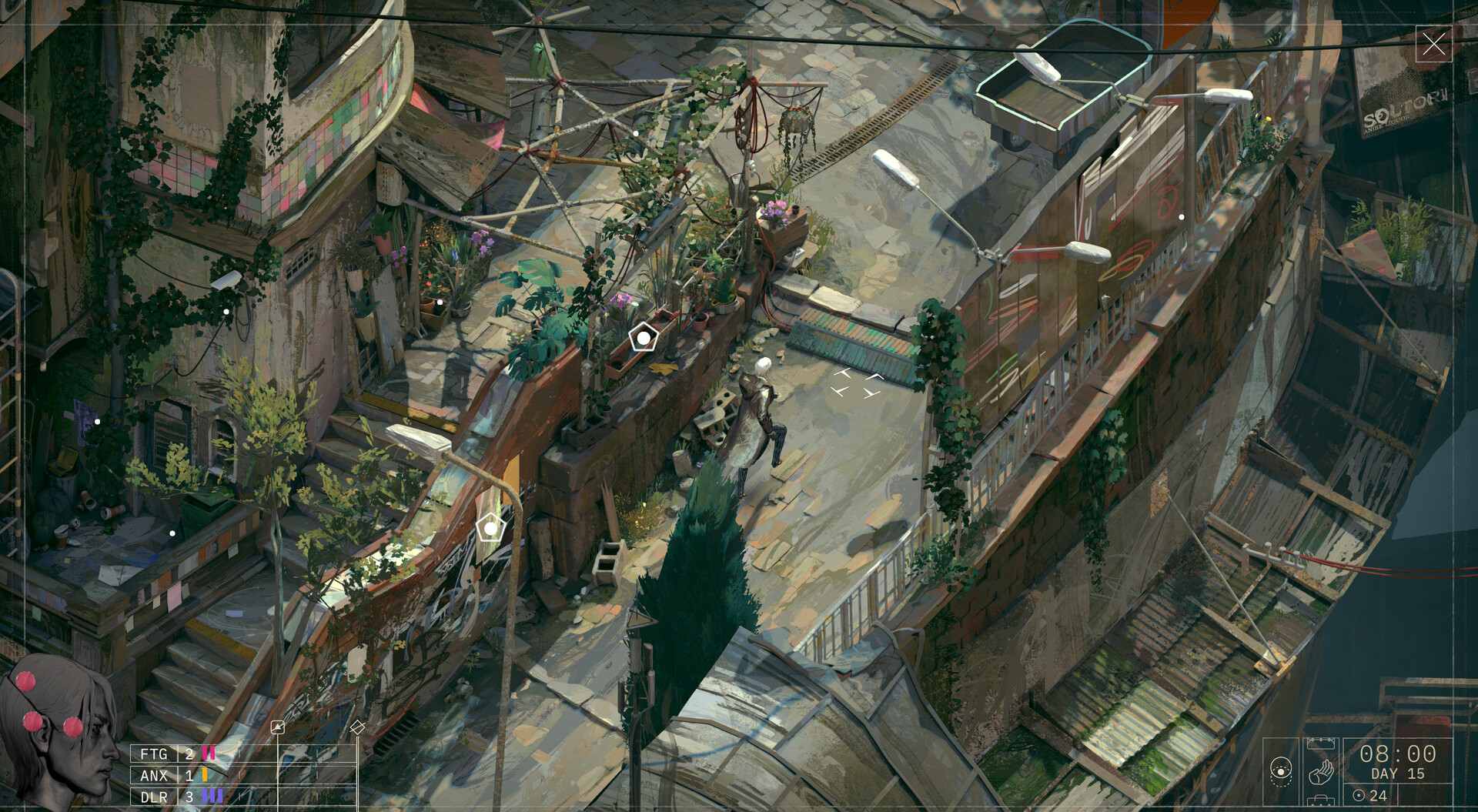
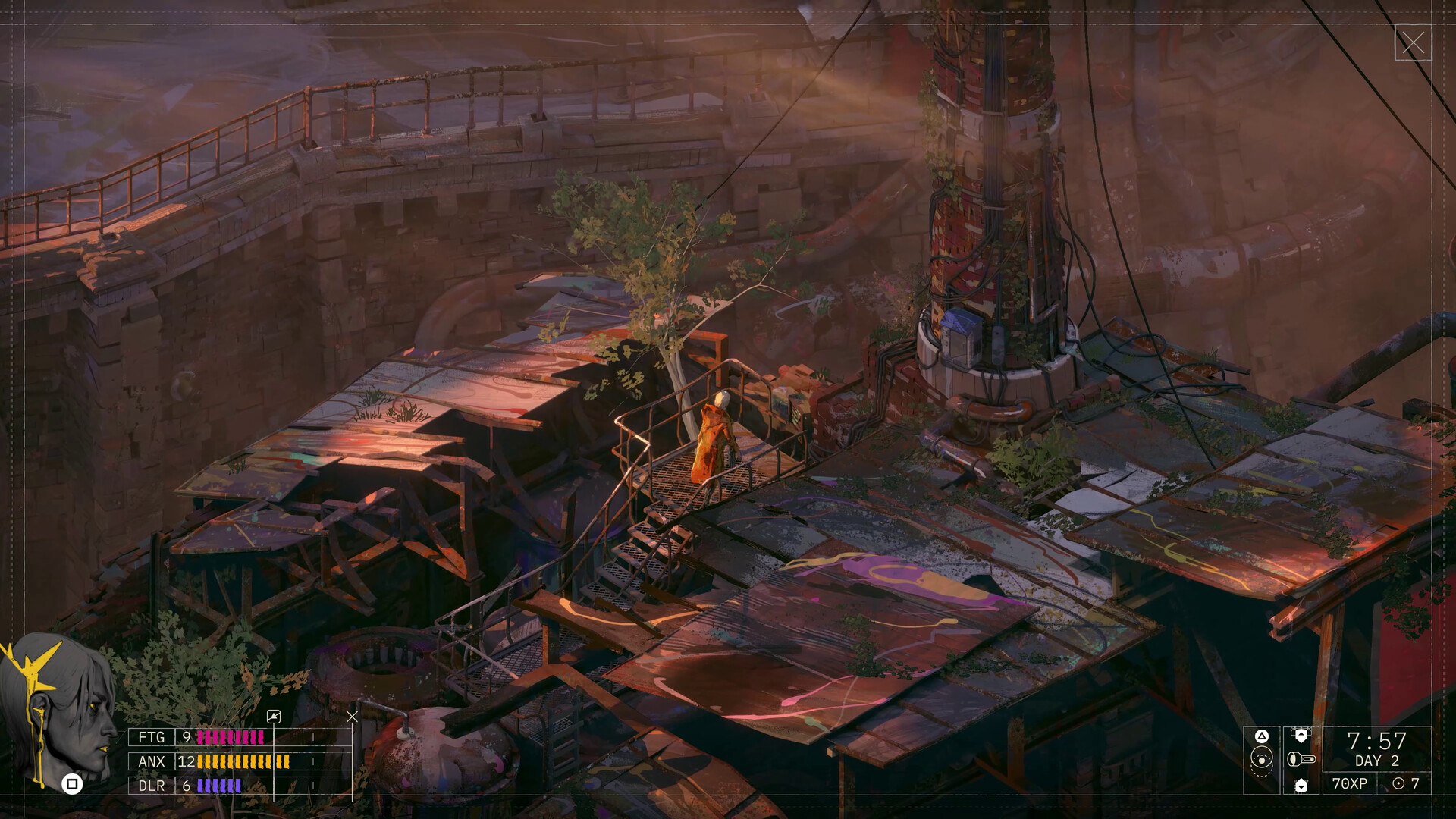
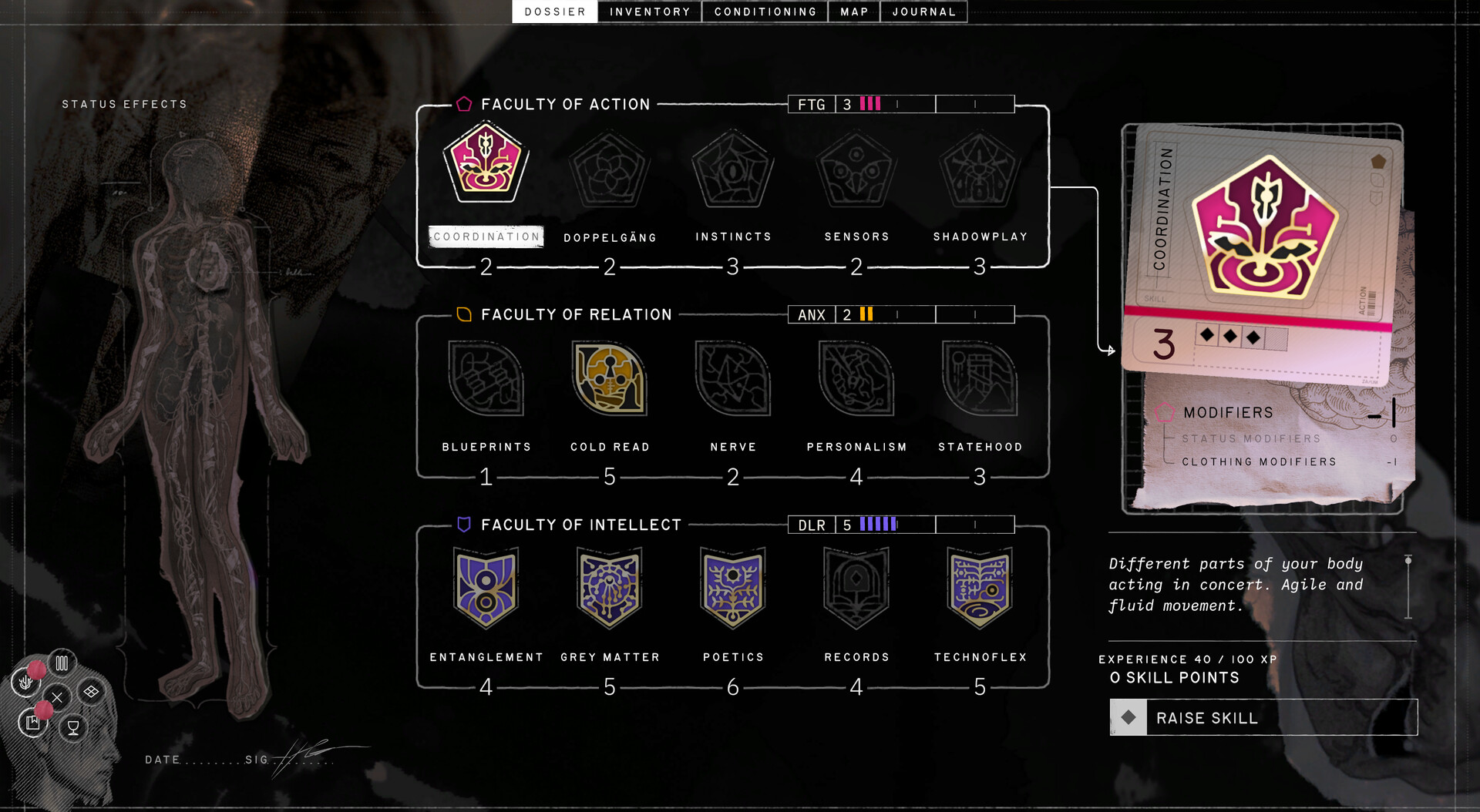
That journey looks and feels a lot like Disco Elysiun. Portofiro is warm and rusted where Revachol was chilly and crooked but no less vibrant, with a wider assortment of locals to chat away with. While Disco’s portraits often felt borderline caricature Zero features a more sketchy impressionistic approach to its cast with models and animations being a bit more varied. It’s a matter of taste though I think I’ve fallen more favorable on Zero Parades’ approach, with the exception of its skills. Where Disco used abstract paintings to represent its various skills, Zero opts for a boy scouts style pin design. Not ugly by any means but I’ll never be tempted to replace the Volition painting on my bedroom wall with a Doppelgang one.
Dress to Impress
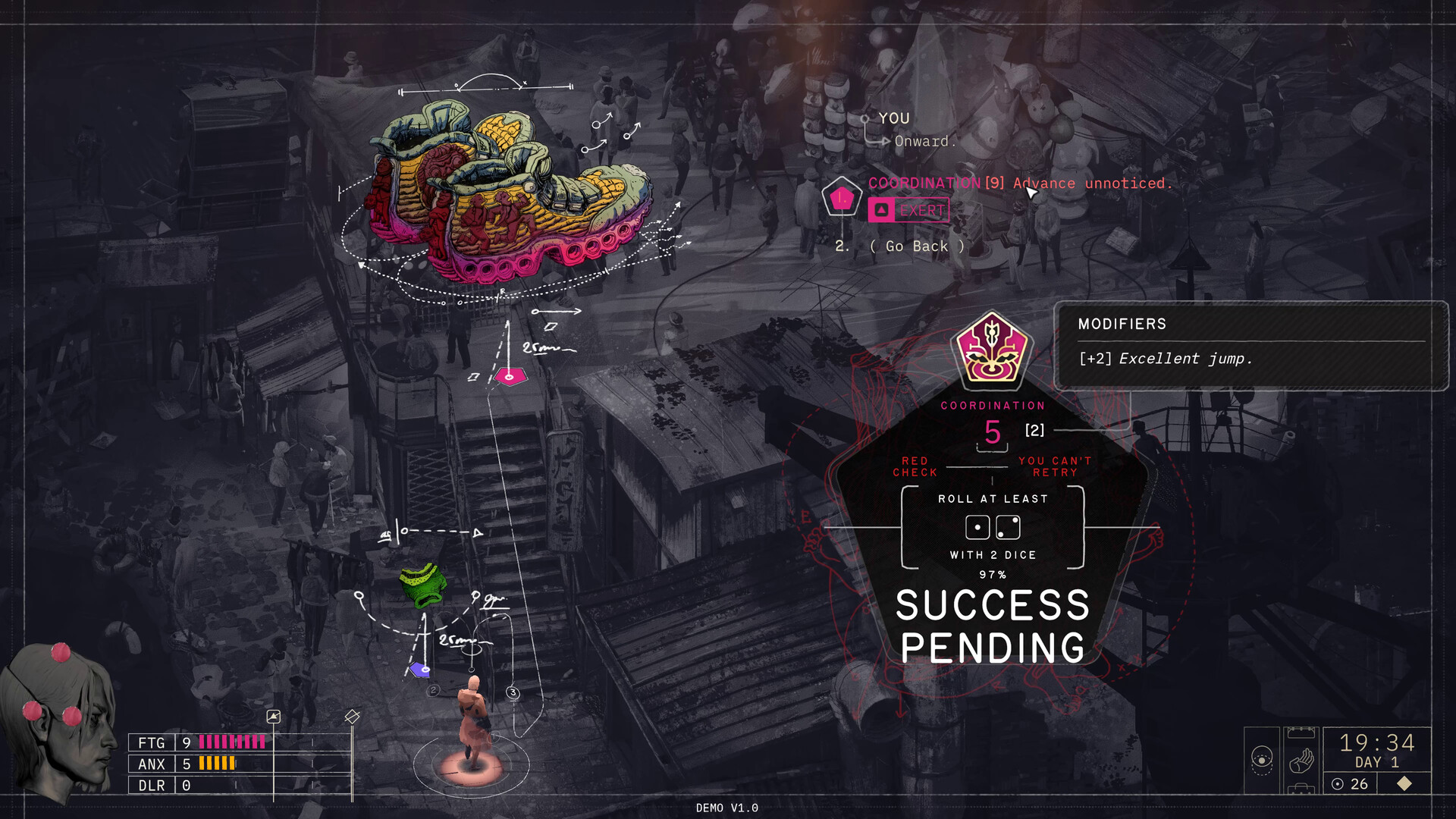
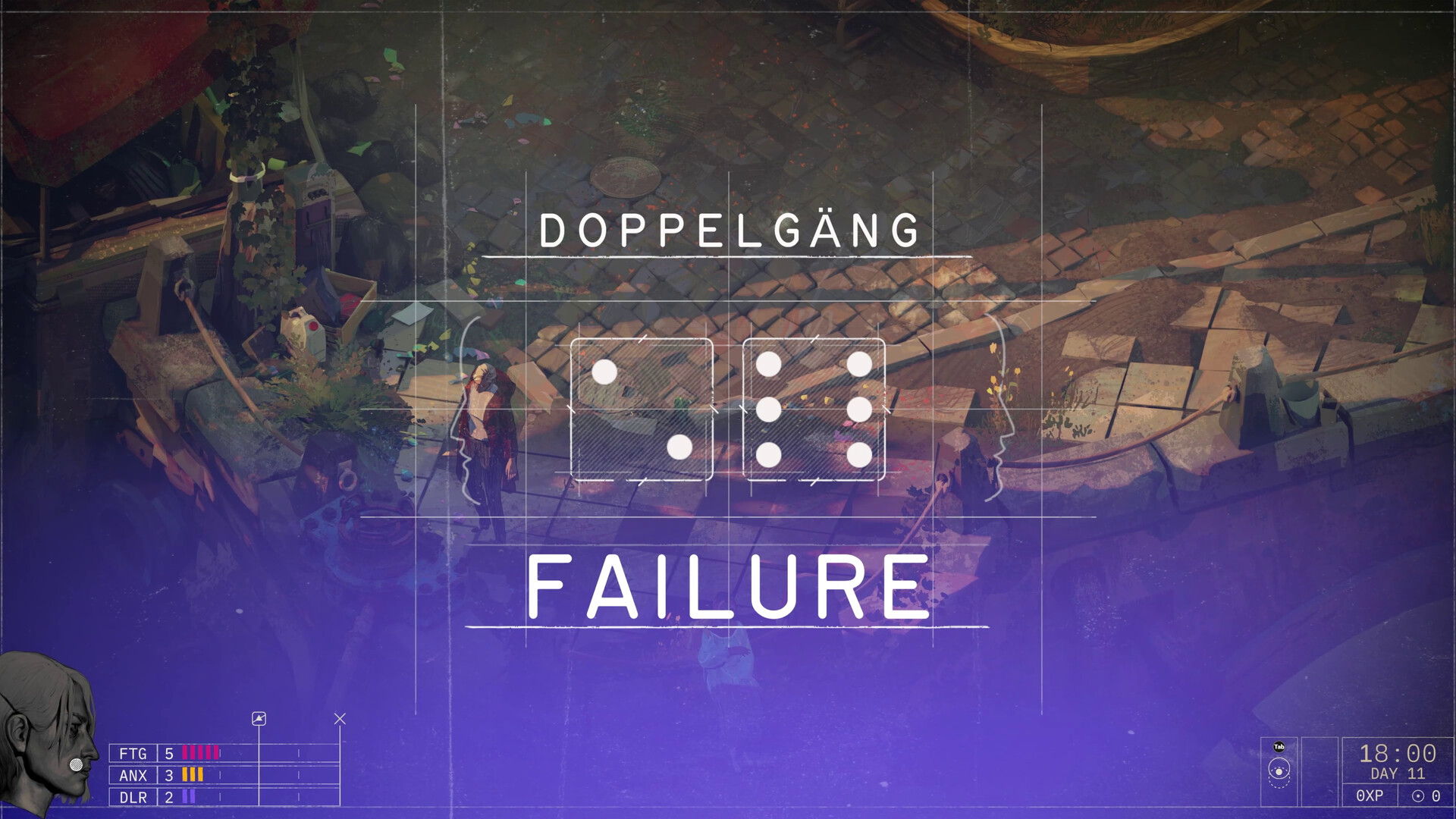
Said skills have also been reduced from the meaty 24 to a more manageable 15, but Zero Parades has balanced the reduction with higher checks. Periodically players will be required to roll the dice to accomplish specific tasks, a process that became negligible by the end of Disco Elysium even with an instant fail for Snake Eyes. Zero consistently expects double digit rolls which even maxed out skills have trouble hitting, feeding into the Condition system. Rebranded from its predecessor, Conditioning allies you to internalize certain philosophies in exchange for bonuses, namely raising the cap on specific skills. It’s a definite improvement on the original system, but sort of a half measure. Certainly more impactful and useful than it was, the system still requires you to know what skills you need to invest in which is a surprisingly difficult prospect. Somehow 15 skills may still be too much for the system as it feels like you’re better off just investing in lesser used skills rather than playing the long game.
This is a shame because the flavor benefits of the system are huge. Early in my time as an Operant I found a manifesto titled “The Wang Way” which imbued me with a deep love of righteous violence and a “how to” manual for building a gun in your basement. It also permanently replaced every instance of ‘kill’ with “wang” in my CASCADE’s dialog. By the end of it all I had nearly maxed out my conditions and even then I had most of my skills full up as well, but I can’t help but feel I would’ve been more deliberate in my choices if I reaped more direct benefits from them. Simply giving the benefits of +1 to relevant skills feels more elegant and weighty compared to the existing system.
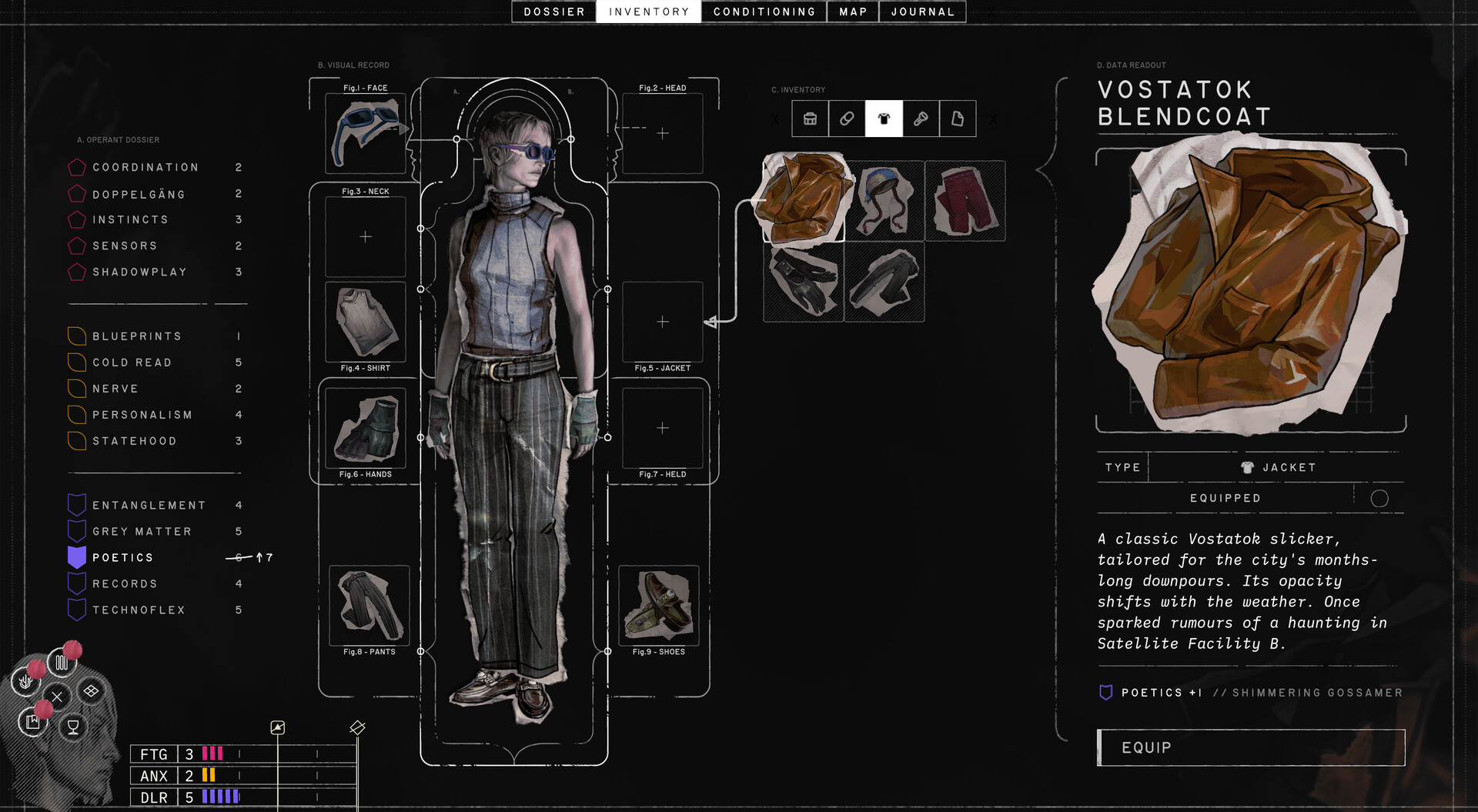
Instead, the bulk of your skill augmentation comes from clothing. Nearly every piece gives a point to one stat and removes one from another, leaving you to constantly juggle outfits between dialog. It’s an awkward system in Disco Elysium and the changes made here make it more necessary without making it more efficient. There’s no way to save outfits or search them by benefit, leaving you to constantly shuffle through them in a tedious chore.
This process doesn’t add meaningful friction to the experience. Never did I think to set my look by what I thought I’d need ahead of time because there was no reliable way to predict it, nor did it seem pertinent. In hindsight, it seems like Zero Parades may have benefitted from a Resident Evil style inventory system, one where you can only carry so much into the streets of Portofiro, requiring you to return to save spaces to swap out tools and disguises rather than just your inventory screen.
Three Classes
Zero Parades puts its skills into three categories which seem to act almost like classes. The intent seems to be for you to choose one of these as a main and another as a “dump” class rather than the shotgun approach I took, but if that’s the case I wish the game had taller fences between them to incentivize it. Playing the game that way does seem to gel with its gameplay systems much better, but the cost to choice and options is high enough I suspect most players will take my approach of an even spread for flexibility. There’s something to be said that I floundered into a jack of all trades, master of none “build” for my CASCADE and my issues with these systems are build specific, but for the cost of this tedium I seem to gain a massive reservoir of actual story to play with, which seems too good to pass on.
The last of these major systems is the pressure mechanic. Similar to the survival mechanics seen in games like Fallout: New Vegas, there meters for fatigue, anxiety, and delirium fill as you encounter the emotions in your adventure. As they fill you incur negatives to your “class” of related skills. Wait too long to reduce them and you may incur a penalty, a permanent loss of a point in a related skill. Lowering the bars is easily done through the various usables you can find across the city, cigarettes and beers especially, but while they reduce one pressure they increase another.
This leads to a bit of an awkward dance where I found myself downing three or four beers and chain smoking to lower anxiety then raise fatigue, then lower fatigue to raise delirium which I hadn’t accumulated much of. Reducing these systems to zero is surprisingly difficult and while you can accumulate intoxicants quickly, you can burn through them just as fast. It feels like a microcosm of the greater “class” system described above, hinting at the games’ concentric design. The pressure system feels so natural I’m surprised I haven’t seen it before, it seems to describe the ebb and flow of stress so well I’ve begun to wonder if I should pick up smoking in real life to try and be more “present.” Still, the lack of an addiction system feels like a major miss especially given what a major part of its predecessor it was. Even if the devs were worried about retreading old ground it seems like another slam dunk for the ‘flavor’ part of the experience to keep your anxiety low through day drinking only for it to shoot back up because you’ve become an alcoholic.
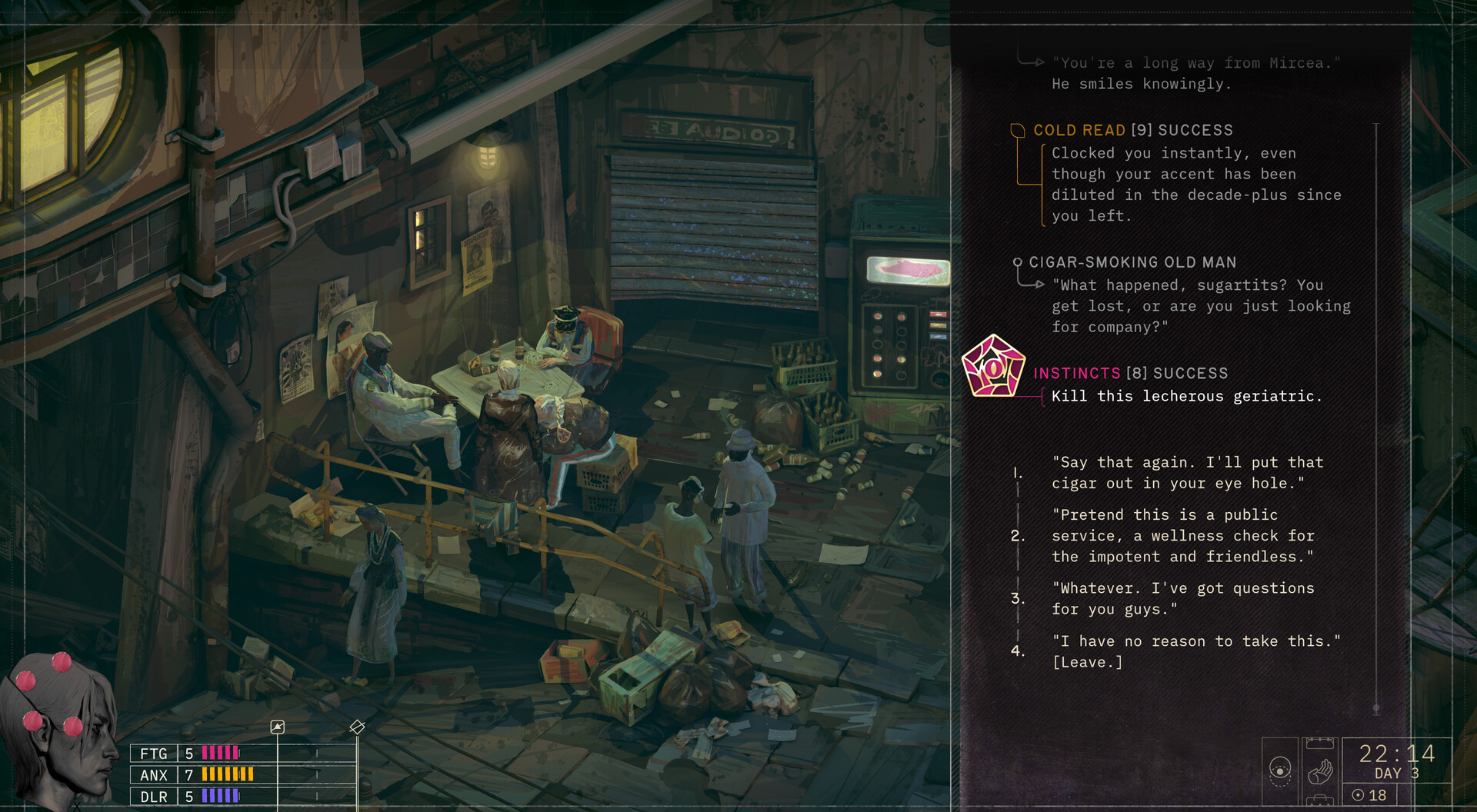
This is all necessary mechanic discourse for a review but let’s be clear, no one is playing Zero Parades to build a character resilient to the game’s systems like in a normal RPG. Zero Parades is a glorified visual novel, its dice rolls doing little more than to make sure you’re staying on the right route. Whether Zero Parades is worth playing or not is entirely reliant on how good its story is and that has made my job much harder because even up to the last moment of the game my opinion swayed greatly. During my time with the title my friend, a Disco loyalist, would pick my brain about it and I would give embargo friendly impressions. Looking back on them if someone told me those same thoughts I would fight them tooth and nail. Far from my first impression of a game trying to live around Disco Elysium, Zero Parades may be a harsh rebuttal. It may be the most cynical game I’ve played.
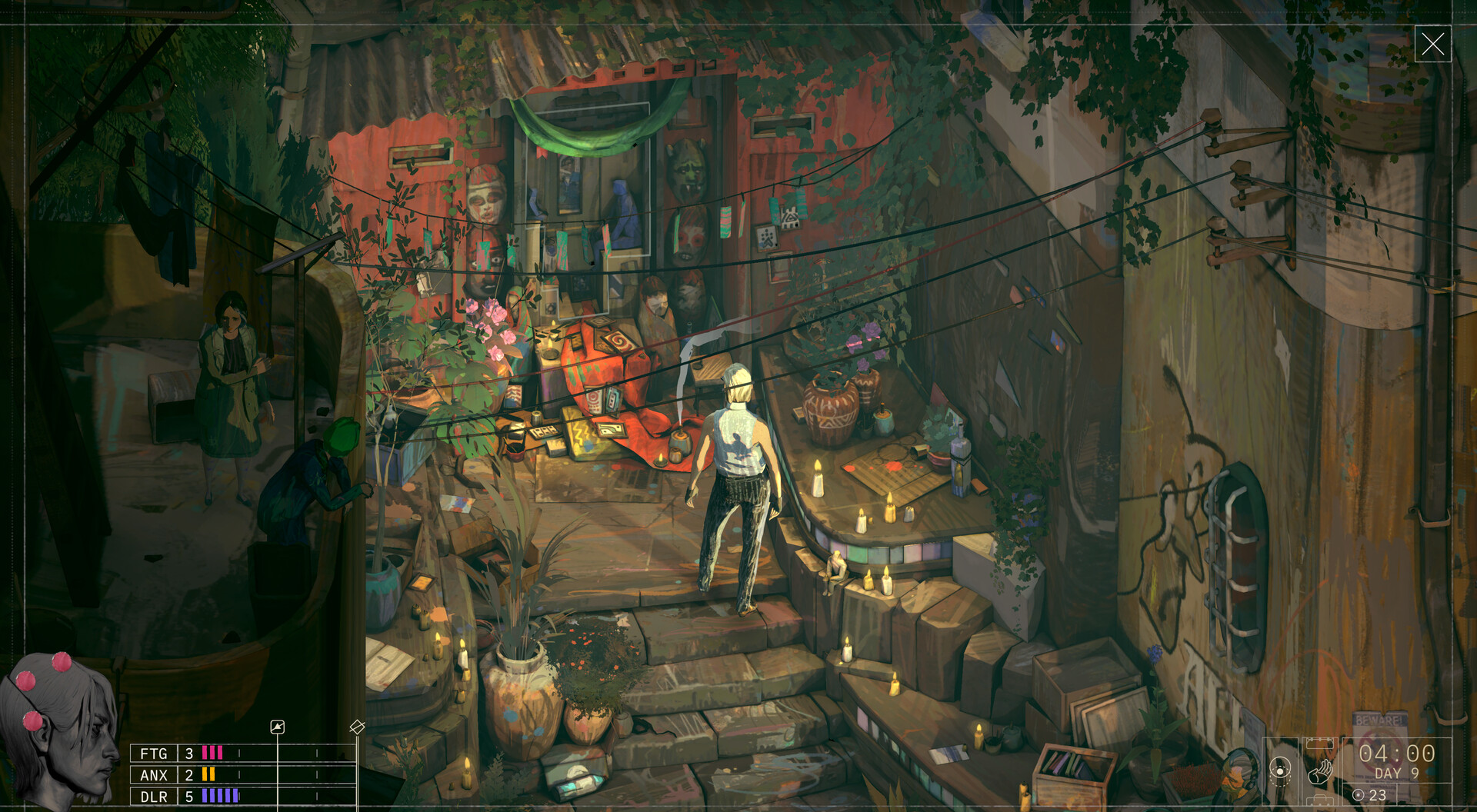
Zero Parades feels like Disco Elysium. If I had no knowledge about what was going on behind the curtain at ZA/UM I don’t think I’d have ever guessed it was written by a different person. Instead, I found myself constantly prying into the gears and cranks to try and see what was in one title and not the other, to discern what had been lost between the two. As I did this, the wraith of ZA/UM drew a circle of salt around me, trapping me so well I didn’t realize it until I was done. Herschel, who I felt initially was a pale imitation of our Disco Detective, seemed to increase in depth as the story went on. By the end, I began to feel closer to CASCADE than maybe any video game character I’ve encountered. In this, did I find CASCADE’s hidden depths, or did I discover my own status as a lesser Du Bois? The further I went the further I fell and as I approached the finale and my view of Herschel changed so to did my view of myself.
Summary
I have racked my brain to try and make sense of the final moments of Zero Parade and the emotion it stirred within me. It all seems to echo the discourse around the firing of Disco Elysium’s lead writer, that of the individual vs the group. In my reappraisal the point of Disco Elysium is failure, living with it, as it is, and past it.
Zero Parades is about being failed. It’s about how your failure affects people you love and how their failures shape you, but beyond that it’s about how the framework we live in prevents us from success. Concentric circles of control and pressure mistaken for love. I would like to wrap my time with Zero Parades up in a bow, but I don’t think that’ll be possible. I’ll need more time and experience than the review process allows to. When I think back on Disco Elysium I recall a dozen or so lines that have returned to me over and over again since playing it. When I think back on Zero Parades, I’ve been caught in the moments where my character didn’t say anything, just understood why they were here and who put them there, and how much it hurts.
9 — Superb
Review copy provided by developer/publisher/PR group
