It’s long been my theory the reason Pokémon has maintained such unwavering popularity over the decades is because each of the core ‘pillars’ of the property offer something distinct. Play the games and find a Pokémon you like? There’s an episode of the show all about it, and a whole slew of trading cards featuring it to collect. Likewise, pull a card of a Pokémon you’ve never seen before and you can go running back to your game to try and dig it up, or see if the show’s gotten to it yet. Even in the early years when Pokémon felt ever present this dichotomy was in play, the show giving depth to a world the Game Boy couldn’t match. There may have been nothing players so desperately wanted to know about than Mewtwo.
I’m assuming. The truth is I didn’t actually play Pokémon until middle school, and though I was fairly obsessed with the show it was through reruns in syndication so I was always a bit behind. By the time I got into Pokémon these elements were all known quantities, but it’s not hard to come to this conclusion. The first batch of Pokémon games had simple, broad stories, more the suggestion of characters than defined ones, and Mewtwo was no different. Following through the games’ content of battles and championships all ends deep in a cave where an ominous and powerful foe waits. Is he an alien? A mutant? Some unknown monstrosity? Tucked away in a dungeon on the other side of the map you can find a diary listing the birth of Mewtwo from another mysterious entity, Mew. And that’s it. You could find Mewtwo among the stacks of early pokemon cards but couldn’t gleam much from it other than a cleaner look. For the first fans in Japan, the Pokémon movie was about the final piece of the puzzle. For everyone else, the title said it all. The first movie of many more.
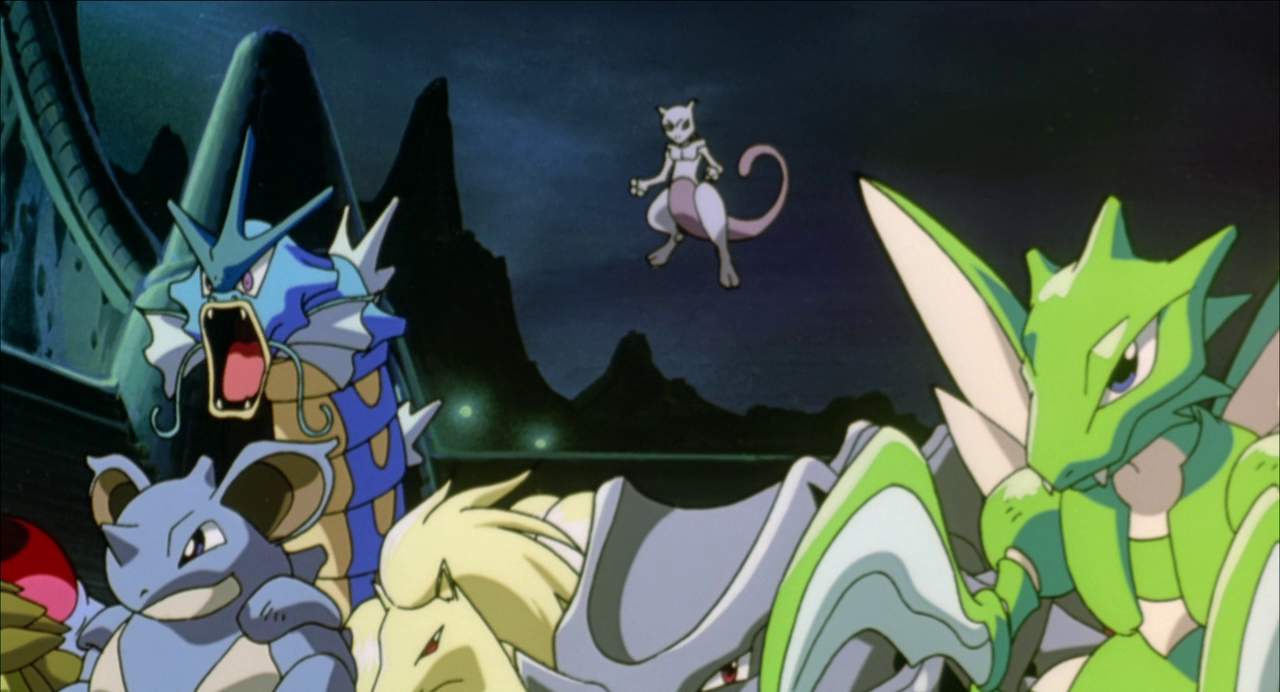
For Psyduck Cinema, that ‘many more’ part is the real draw. I stopped watching Pokémon probably around the time I started taking games more seriously, mostly because I stopped watching TV and stopped seeing them advertised. It would be easy to say this project was born out of nostalgia, but the reality is my interest skews more academic. Since high school I’ve grown obsessed with something I call a ‘Macro Narrative,’ a narrative written continuously over years, sometimes decades.
My earliest interests in it came from my indulgence into manga like Dragon Ball and One Piece and eventually lead me into pop cinema like Godzilla and prestige TV. The sheer amount of these works is a major factor in my interest, and so I’ve often wondered, what do these Pokémon movies look like now? What does the fifteenth tie in film to the Pokémon franchise look like? Does it stagnate, or does it change with the times? Does the repetition hinder it, or help it? Is it even approachable outside of the series, or is it completely episodic? To answer these questions, to start this process, we have to begin with the original and in this context rather than a warm return home it feels a lot more like a hill you have to push your car over to get moving. Well, here I am at the top and out of obligation you have to ask me if it was any good and I have to be the one to tell you, no not really.
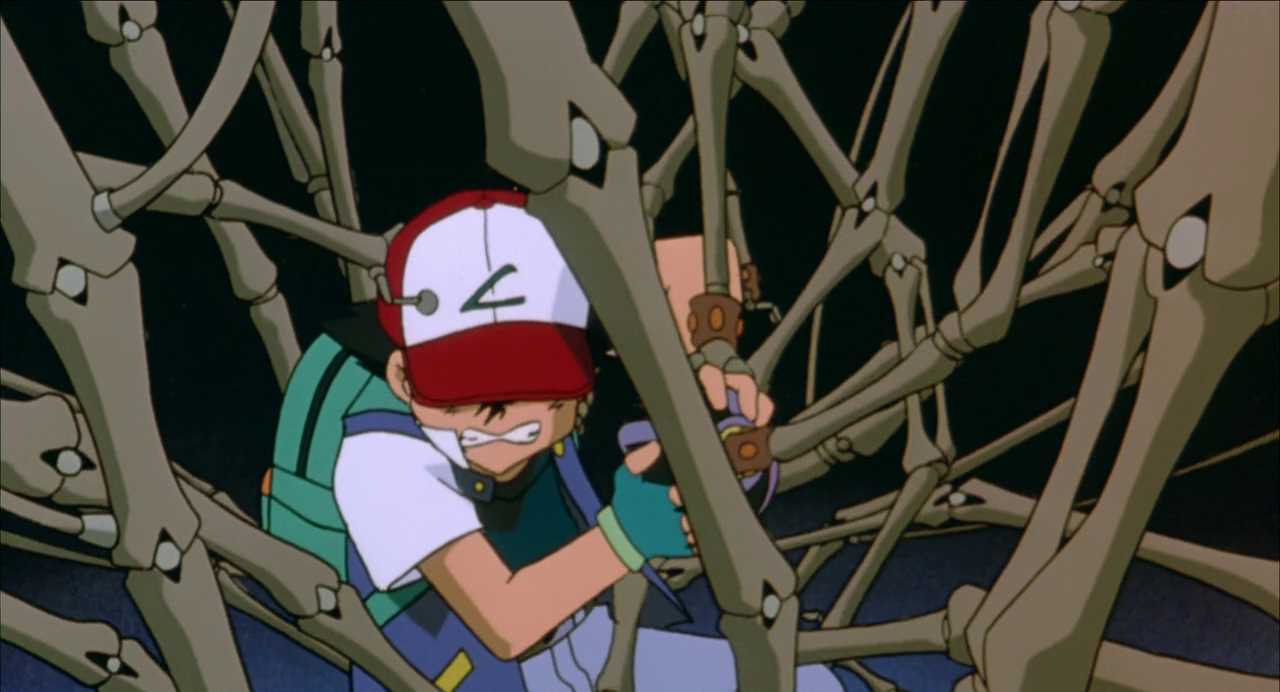
The first Pokémon Movie is a mess. It is such a mess that before I can really tell you what’s wrong with it, I have to explain which of the half dozen versions I watched. It turns out the original Japanese release in theaters opens directly with Mewtwo’s rampage under Giovanni. Nearly everything before this sequence was added in home releases or animated for the North American release. That version, likely the one you watched, only includes some of this new content, namely a quick and trippy edit of Mewtwo’s creation in the lab. The full Japanese release included a lengthy prologue where a gestating Mewtwo connects psychically with several other clones. It’s a cute side story, but it feels very out of place in the film’s placement. The North American release cut this in favor of a short focusing on Pikachu at a park in order to make up the lost time.
This isn’t the only change for the American market I think benefitted the film. Much of the film’s score was changed as well. Watching the Japanese version, I couldn’t help but notice some sequences felt off. Infamously, the American cut includes pop and R&B tracks over some sequences where more standard series fare was originally, but even more typical tracks were replaced during action sequences. One, the scene where Mewtwo captures the Pokémon of the trainers, stood out to me. In the Japanese version the score has a heavy xylophone over it, which may have been a deliberate decision to cut some of the tension for younger viewers. I can’t see this being effective since the actual imagery of the scene is pretty intense and the American score seems to keep the tone much better.
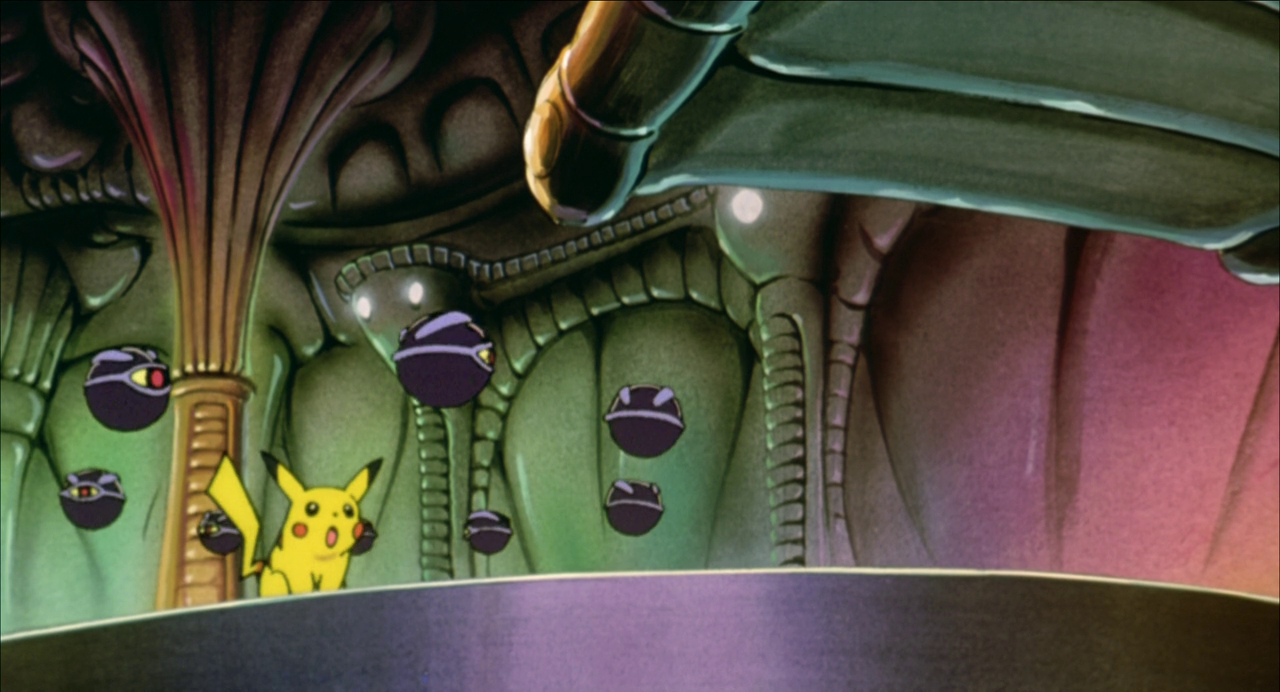
I was surprised by just how much I found myself preferring the changes in the American release because, on an ideological level, I find these sorts of alterations offensive. Glorified commercial or not, the people behind these sorts of projects are often real artist who take the oppurtunity to try and make something compelling. Just like Larry Hama, who wrote some of the greatest Wolverine comics in the character’s history, got his start writing for GI Joe, the team behind these Pokémon movies try to elevate the material into something worth selling in the first place. That creative spirit can be felt in much of the film’s first half, where it focuses on Mewtwo and his strife. His birth, his life in stasis, his rampage, all are told very effectively and paint a tragic Frankenstein tale. With some minor script changes, you could probably cut it from Pokémon altogether and make a compelling short film, similar to the original Digimon short. But when the heroes of the anime show up, this all feels distant. The Mewtwo of the second half, in both versions of the script, feels completely seperated from these events. It’s hard to make sense of Mewtwo’s plan or intentions, and the more expanded the prologue becomes the harder it is to connect them to that past.
Japan’s film industry has a curious sort of secondary tier for smaller length tie-ins. Very common in anime and kid’s shows like Super Sentai, these specials are usually longer than an episode but shorter than a full release. Here, Pokémon The First Movie introduces Mewtwo as a belittled beast at the hands of his master before escaping. Suffering from severe self loathing, Mewtwo plans to clone the Pokémon of others just as he was and force them into battle. Defeating the enemy this way doesn’t just prove Mewtwo’s own worth, it proves him superior.
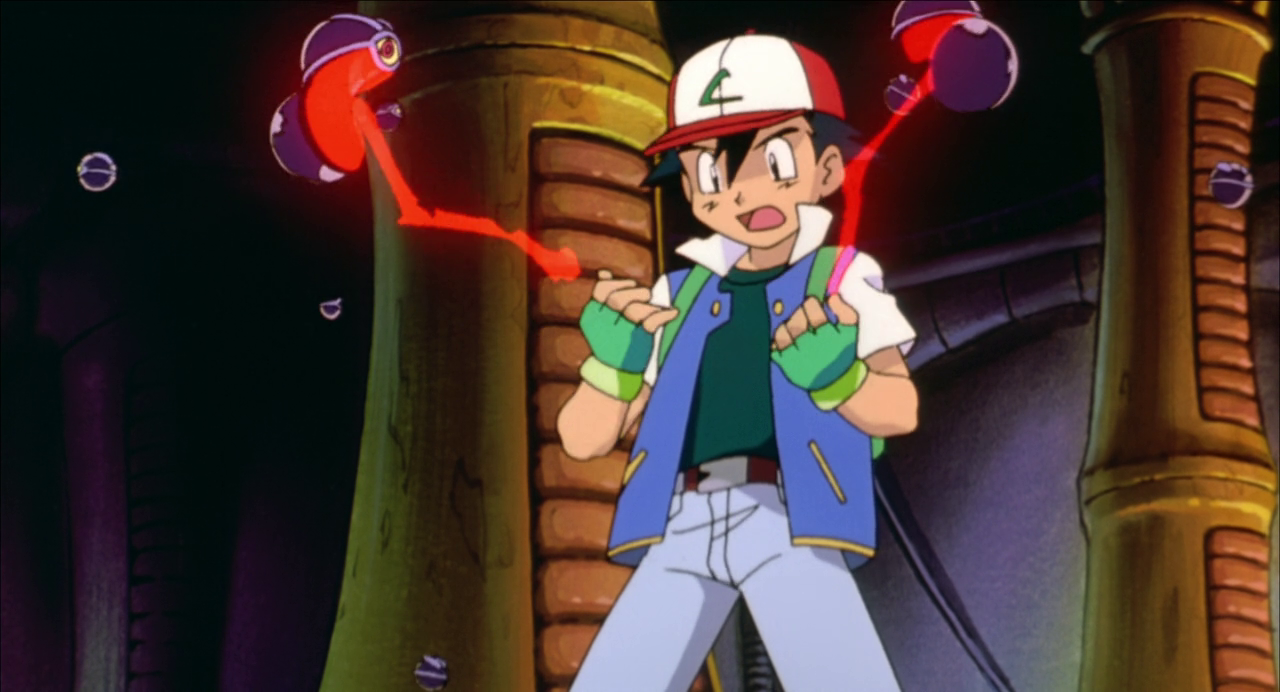
His plans are disrupted by our hero Ash who throws himself into danger to save his partner Pikachu, and frees the original Pokémon alongside them. The conflcit grows, Ash is nearly killed, and moved by the terror he’s caused Mewtwo turns over a new leaf. The extended prologue’s true purpose is to add belief to this final turn, by showcasing Mewtwo’s ‘humanity’ through his youth we see he wasn’t irredeemably evil. But Mewtwo’s hero turn isn’t bad because he was irredeemably evil, it was bad because it’s not earned. Mewtwo must have been able to tell from the way they act that the trainers and Pokémon cared for one another so this moment of shared grief feels like too little to justify a repeal of what likely took months of concentrated action. As a result the addition only serves to bloat a story rather than enrich it.
You might look at all this and say I’m expecting too much from a kid’s movie, but I’ve seen it done before. Most of Mewtwo’s drama can also be found in the Sonic games that feature anti-villain Shadow, whose story was fairly well adapted in the most recent film. There’s almost complete overlap with the intended audience for these series and one seems far more successful in execution, so the potential is there. Instead, the flaws of The First Movie are deeper than holes in walls that we can spackle scenes over. It’s structural, if not foundational.
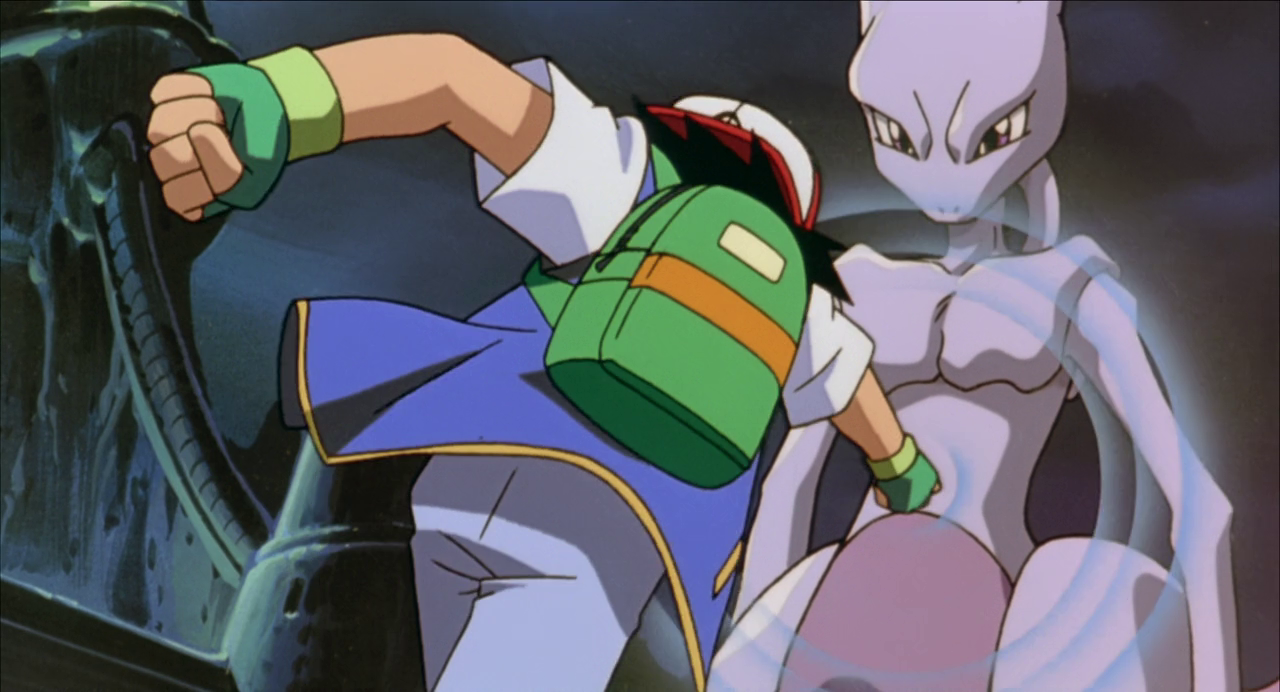
While the movie may reveal the origins of Mewtwo it doesn’t necessarily give us much to work with as far as Mewtwo himself. Compared to the series, where individual Pokémon managed to exude personality without dialog and minimal screentime, Mewtwo feels flat. The exploration of his character is biographical, but doesn’t give much in terms of personality. Aside from a handful of scenes ‘aura farming’ it’s unclear what Mewtwo’s personality is. Compare this to his progenitor Mew, also largely a mystery before this, who appears playful and joyous throughout, or Charizard who appears to bubbling with rage the entire time he’s on screen.
Maybe the biggest missed opportunity here is that Mewtwo’s one trait, his severe self doubt, is one shared by our hero. While often hot headed, Ash was just as defined by a nagging belief he didn’t have what it takes to make it as a champ. The obvious difference here being Ash has a strong support network, whereas Mewtwo had almost nothing, his clones are in part an attempt to create one. Mewtwo, seeing himself embodied in what he considers his exact opposite, would be a palpable way to give him a little depth. It would also open the oppurtunity for Mewtwo to focus his assault on Ash personally. I can imagine a moment where Mewtwo narrows his eyes and Ash has to parkour his way through his lab to avoid being killed.
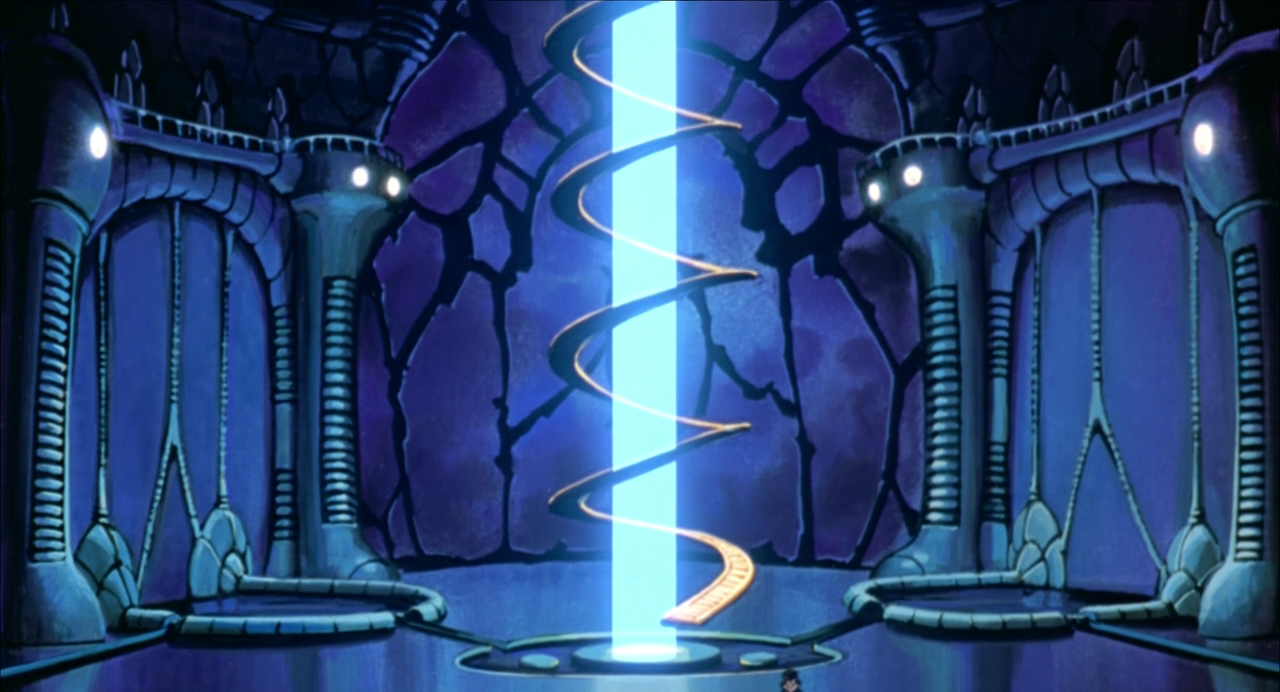
If there’s one thing I unequivocally love about the movie, it’s the design work. The opening scene on a cliff is idyllic and sweet as we’ve come to expect from the series, but Mewtwo’s island is one of the best locales in the franchise. Anime in the 90s had a love affair with the works of H.R. Giger, giving rise to an infection of ‘biopunk’ that even found its way here. Mewtwo’s banquet hall filled with orange vasculature, the lab dark and oppressive, even the battlefield which is little more than a dirt field illicit a unique vibe when contrasted with the endless dark around it.
From the outset I’ve always felt like the title of the film was bold and arrogant, The FIRST Movie. But now that I’ve returned to it it’s hard not to feel like it’s a sheepish warning. “It’s our first movie so please be gentle.” Returning to a movie I’ve seen so much and trying to appraise it with fresh critical eyes has been a unique, and in some ways, sad experience. It may be best for The First Movie to stay in your memories, a place to return to free of reappraisal and solely to dip into nostalgia. Or just do what the first fans of Pokémon did when they met that weird monster at the back of a cave, and let your imagination run wild with possibility. It’ll probably be more fulfilling.
My final ranking for Pokémon: The First Movie is a basic, normal Pokéball.